
Finding a practical way to listen to music, podcasts, navigation prompts, or calls while wearing a helmet can be difficult. Traditional earbuds may become uncomfortable under a helmet, while standard headphones usually do not fit at all. The Outdoor Tech Chips XV Universal Helmet Headphones are designed specifically to solve that problem.
Instead of covering your ears like normal headphones, the Chips XV speakers fit inside compatible helmet audio pockets. They connect wirelessly to a smartphone and allow riders to control music, calls, volume, tracks, and voice assistants without constantly reaching for their phone.
Outdoor Tech lists Bluetooth 5.3, up to 15 hours of talk/play time, approximately 30 feet or 10 meters of wireless range, fast charging, sweat and water resistance, cold-temperature resistance, and compatibility with most helmets among the key features of the Chips XV.
Whether you ski, snowboard, cycle, ride a motorcycle, or use a powersports helmet, understanding how this helmet audio system works can help you decide whether it belongs in your setup.
What Are Outdoor Tech Chips XV Universal Helmet Headphones?
Outdoor Tech Chips XV are compact wireless speakers designed to sit inside the audio liner or ear pockets of compatible helmets.
They are different from conventional over-ear headphones because you do not wear a separate headband. Once installed in the helmet, the speakers remain positioned near your ears while the helmet itself holds them in place.
This design makes them particularly useful for activities where wearing a helmet is already necessary.
Common uses include:
- Skiing
- Snowboarding
- Cycling
- Mountain biking
- Motorcycle riding
- Powersports
- Outdoor recreation
- Listening to podcasts while wearing a helmet
- Taking hands-free calls
- Using voice assistants
The idea is simple: instead of trying to squeeze earbuds or headphones underneath your helmet, the audio system becomes part of the helmet setup.
Outdoor Tech Chips XV Key Specifications
The Chips XV combine Bluetooth connectivity with a compact helmet-friendly design.
| Feature | Outdoor Tech Chips XV |
|---|---|
| Connection | Bluetooth 5.3 |
| Wireless Range | Around 30 ft / 10 m |
| Talk/Play Time | Up to 15 hours |
| Standby Time | Around 60 days |
| Charging Time | Around 25 to 45 minutes |
| Controls | Two-button control system |
| Voice Assistant | Siri and Google Assistant |
| Audio Codecs | SBC and AAC |
| Weather Protection | Sweat and water resistant |
| Cold Resistance | Yes |
| Helmet Compatibility | Designed for most helmets with suitable audio pockets |
| Speaker Size | Approximately 2 inches in diameter |
| Thickness | Approximately 0.6 inches |
| Operating Temperature | Approximately -10°C to 45°C |
These specifications are based on Outdoor Tech’s published product information.
Why Helmet Audio Is Different From Regular Headphones
Helmet audio has a different job from everyday headphones.
With normal headphones, comfort mainly depends on the ear cups and headband. With helmet speakers, comfort depends on how well the speakers integrate with the helmet.
A good helmet audio system needs to balance several factors:
- Low-profile speaker construction
- Reliable Bluetooth connectivity
- Controls that work with gloves
- Sufficient battery life
- Resistance to sweat and moisture
- Cold-weather performance
- Clear audio without excessive bulk
- Easy installation and removal
The Outdoor Tech Chips XV Universal Helmet Headphones are designed around these requirements rather than simply adapting regular headphones for outdoor use.
Universal Helmet Compatibility
One of the biggest attractions of the Chips XV is their universal approach.
Outdoor Tech states that the headphones are compatible with most helmets. However, “universal” should not be interpreted as guaranteed compatibility with every helmet ever made.
What Kind of Helmet Works Best?
The best match is usually a helmet that already contains removable ear pads or dedicated audio pockets.
The speaker discs can then sit inside those areas without significantly changing the helmet’s fit.
Before buying, check:
- Whether your helmet has speaker pockets
- The available space inside each ear pad
- Whether the ear pads can be opened
- Whether adding speakers changes helmet pressure
- Whether the speakers remain secure while moving
- Whether the helmet manufacturer allows audio accessories
The Chips XV are approximately 2 inches in diameter and 0.6 inches thick, so checking the available space inside your helmet is worthwhile.
Ski and Snowboard Helmets
This is one of the most natural applications for helmet headphones.
Many modern ski and snowboard helmets include removable ear pads with pockets specifically intended for audio inserts. That allows the speakers to sit close enough to the ears for listening without requiring traditional earbuds.
Bike and Mountain Bike Helmets
Compatibility can vary more with cycling helmets.
Some full-face mountain bike helmets provide suitable areas for audio inserts, while lightweight road cycling helmets generally do not have traditional ear pockets.
Helmet design matters more than simply whether it is classified as a bike helmet.
Motorcycle and Powersports Helmets
The Chips XV may also work with suitable motorcycle and powersports helmets, particularly when there is enough room around the ears for speaker inserts.
However, motorcycle riders should consider wind noise, helmet insulation, traffic awareness, local rules, and whether they need a dedicated intercom system rather than primarily personal audio.
Bluetooth 5.3 Connectivity
The Chips XV use Bluetooth 5.3 for wireless communication.
That allows the system to connect to compatible smartphones and other Bluetooth audio devices without running a cable from the helmet to the phone.
Once paired, users can listen to:
- Music
- Podcasts
- Audiobooks
- Navigation instructions
- Phone calls
- Group-chat audio from compatible apps
- Voice assistant responses
The published operating range is around 30 feet or 10 meters.
In normal riding situations, your phone will probably remain much closer than that, whether it is stored in a jacket, backpack, pocket, or mounted nearby.
Sound Quality and Hi-Fi Audio

Outdoor Tech markets the Chips XV as providing Hi-Fi sound and lists support for SBC and AAC audio codecs.
For helmet headphones, however, sound quality is affected by more than the speakers themselves.
The position of each speaker matters significantly.
If a speaker sits:
- Too high
- Too low
- Too far forward
- Too far behind the ear
the audio can sound noticeably weaker.
Correct positioning allows the speakers to sit closer to the ear canal and generally improves clarity and perceived volume.
Music Performance
Helmet speakers are best viewed as an outdoor audio solution rather than a replacement for premium audiophile headphones.
Their main advantage is convenience. You can listen without inserting earbuds deeply into your ears or trying to fit bulky headphones under protective equipment.
Podcasts and Spoken Audio
Podcasts, audiobooks, navigation prompts, and other spoken content are especially suitable for helmet audio because the primary goal is clear speech rather than heavy bass reproduction.
Two-Button Controls
One of the more useful aspects of the Outdoor Tech Chips XV design is its simplified control system.
Outdoor Tech says its two-button interface can handle functions including:
- Volume up
- Volume down
- Track forward
- Track backward
- Play
- Pause
- Answer calls
- End calls
- Activate Siri
- Activate Google Assistant
These controls allow many everyday functions to be performed without taking out a smartphone.
Why Glove-Friendly Controls Matter
Tiny headphone buttons can become frustrating when skiing or snowboarding.
Cold fingers, thick gloves, and moving equipment make precise controls difficult to operate.
Large or simplified helmet controls reduce the amount of attention required to change a song or adjust volume.
This is especially valuable in winter conditions where removing your gloves simply to control your music can be inconvenient.
Battery Life
Battery performance matters for any helmet audio system because charging during an outdoor session is rarely practical.
Outdoor Tech rates the Chips XV for up to 15 hours of talk/play time and around 60 days of standby time.
That theoretical battery capacity should be sufficient for many full-day recreational sessions.
Actual battery performance can still vary depending on factors such as:
- Listening volume
- Ambient temperature
- Call usage
- Bluetooth activity
- Battery age
- Charging habits
Extremely cold environments can also affect rechargeable battery performance in general.
Fast Charging
Outdoor Tech lists an approximate charging time of 25 to 45 minutes for the Chips XV.
That can be particularly useful when you discover shortly before leaving that your helmet audio system was not charged overnight.
Faster charging reduces the amount of preparation required between riding sessions.
Cold-Weather Performance
Winter sports create challenges that regular consumer headphones may not be designed to handle.
Outdoor Tech lists an operating temperature range of approximately -10°C to 45°C and a storage range of approximately -20°C to 60°C for the Chips XV.
This makes cold-temperature resistance particularly relevant for:
- Ski resorts
- Snowboarding
- Winter cycling
- Snowmobile and powersports use
- Cold-weather outdoor recreation
Users should still follow the manufacturer’s operating and storage recommendations, especially in extreme weather.
Sweat and Water Resistance
Outdoor equipment regularly encounters moisture from snow, sweat, condensation, or changing weather conditions.
The Chips XV are described as sweat and water resistant.
That is useful for active sports, but water resistance should not automatically be interpreted as permission to completely submerge the headphones.
Normal care still matters.
After a wet session, allowing the equipment and helmet liner to dry before storage can help keep the overall setup in better condition.
Calls and Voice Assistant Support
Helmet headphones become more useful when they handle more than music.
The Chips XV support phone calls as well as Siri and Google Assistant functionality.
Voice assistant access can help with tasks such as:
- Starting music
- Making a call
- Changing playlists
- Asking simple questions
- Using supported phone functions
The practical advantage is reduced dependence on manually operating a phone while wearing gloves.
However, voice recognition performance may vary in environments with substantial wind, traffic, or surrounding noise.
How to Install Outdoor Tech Chips XV in a Helmet
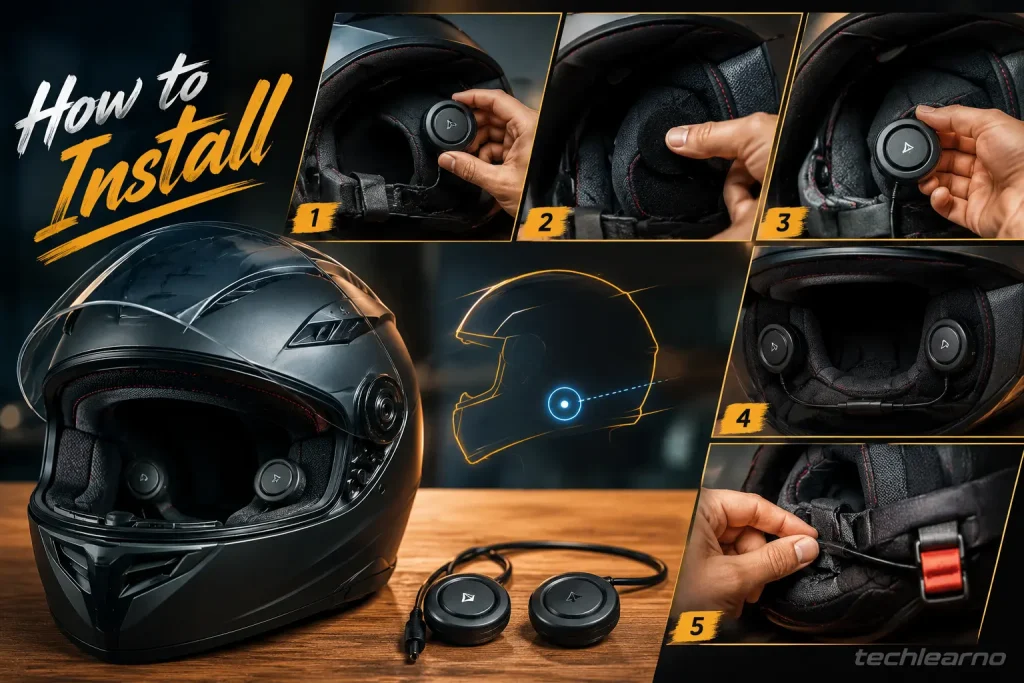
Installation depends on the helmet, but the general process is straightforward.
Check the Ear Pads
Remove or open the helmet’s ear pads according to the helmet manufacturer’s instructions.
Look for dedicated audio pockets or recessed areas designed for speakers.
Position the Speakers
Place one speaker on each side of the helmet.
Try to align the center of each speaker as closely as possible with the center of your ear.
Secure the Speakers
Make sure the speakers cannot shift significantly while you put the helmet on or remove it.
Reassemble the Ear Pads
Close or reinstall the helmet liner carefully.
Do not force a speaker into an area that does not have sufficient space.
Test the Helmet Fit
Put the helmet on before going outdoors.
The speakers should not create excessive pressure against your ears or change the helmet’s intended fit.
Pair Your Device
Turn on the Chips XV and connect them through the Bluetooth settings on your compatible device.
After pairing, test music, volume controls, calls, and voice assistant functions.
Getting Better Sound From Helmet Speakers
Speaker positioning can make a bigger difference than many users expect.
If the volume feels lower than expected, adjust the placement before assuming there is a problem with the headphones.
For better results:
- Center the speakers directly over your ears
- Keep unnecessary padding from blocking the speakers
- Confirm both speakers sit at similar positions
- Test placement while actually wearing the helmet
- Use a comfortable listening volume
- Make sure the Bluetooth connection is stable
Even moving a speaker slightly can change how clearly the sound reaches your ear.
Outdoor Tech Chips XV vs Earbuds vs Regular Helmet Speakers
| Feature | Chips XV Helmet Headphones | Wireless Earbuds | Basic Wired Helmet Speakers |
|---|---|---|---|
| Fits inside compatible helmet | Yes | Worn inside ears | Usually |
| Bluetooth | Yes | Usually | Often no |
| Integrated helmet use | Strong | Limited | Strong |
| Glove-friendly control | Designed for helmet use | Often difficult | Varies |
| Phone calls | Yes | Usually | Varies |
| Voice assistant | Yes | Usually | Varies |
| Long-session ear comfort | Depends on helmet positioning | Can create ear pressure | Depends on speaker |
| Cable to phone | No | No | Often |
| Winter-focused design | Yes | Not always | Varies |
| Easy to lose individually | Low | Higher | Low |
The Chips XV make the most sense for someone who wants a dedicated helmet audio setup rather than earbuds that must be inserted and removed every time the helmet is used.
Outdoor Tech Chips XV vs Traditional Headphones
Traditional over-ear headphones provide a completely different experience.
They can offer stronger isolation and larger drivers, but they are generally incompatible with properly fitted sports helmets.
Helmet speakers sacrifice some of that traditional headphone enclosure in exchange for:
- Better helmet integration
- Less bulk around the head
- Easier use with protective gear
- Controls designed around outdoor activity
- No additional headphone headband
That tradeoff is exactly why helmet-specific headphones exist.
Best Uses for the Chips XV
The Outdoor Tech Chips XV Universal Helmet Headphones may be particularly suitable for several types of users.
Skiers
Skiers can keep speakers installed inside compatible helmet ear pads and avoid dealing with separate earbuds each time they gear up.
Snowboarders
For snowboarders who spend several hours on the mountain, long battery life and glove-friendly controls are especially useful.
Mountain Bikers
Full-face mountain bike helmets with appropriate speaker space may benefit from low-profile wireless helmet audio.
Motorcycle and Powersports Riders
Riders who primarily want music, navigation, calls, or other smartphone audio may appreciate a helmet-mounted system.
Those requiring rider-to-rider communication should separately determine whether a dedicated motorcycle communication system would better suit their needs.
Advantages of Outdoor Tech Chips XV
The strongest benefits include:
- Designed specifically for helmet audio
- Bluetooth 5.3 connectivity
- Up to 15 hours of published talk/play time
- Approximately 25 to 45-minute charging time
- Sweat and water resistance
- Cold-temperature resistance
- Siri and Google Assistant support
- Music and phone-call controls
- Approximately 30-foot Bluetooth range
- Works with many helmets containing suitable audio pockets
- No headphone headband
- No wired connection to the phone
- Compact speaker design
Potential Limitations
No audio system is suitable for every rider.
Consider these points before buying:
- Not every helmet has suitable audio pockets
- Speaker positioning affects sound quality
- Wind and environmental noise may affect listening
- A helmet may become uncomfortable if speaker space is limited
- Helmet speakers do not isolate external sound like sealed headphones
- Riders needing advanced intercom communication may require a different type of system
- Bluetooth performance can depend on the connected device and environment
- High listening volumes may reduce awareness of surroundings
Safety and Situational Awareness
Audio should never become more important than awareness of your surroundings.
This is especially important while:
- Cycling near traffic
- Skiing crowded runs
- Snowboarding around other riders
- Operating motorcycles
- Using powersports equipment
Keep the volume at a level that allows you to remain aware of warnings, approaching vehicles, other riders, and relevant environmental sounds.
Also check any local regulations that may apply to headphone or audio use while operating a vehicle.
How to Choose a Compatible Helmet

Do not choose a helmet only because it works with headphones.
A helmet’s protective fit and suitability for the activity should remain the priority.
After selecting an appropriate helmet, check whether it includes:
- Removable ear pads
- Audio-ready ear pockets
- Enough space for approximately 2-inch speaker discs
- Secure routing or positioning for audio hardware
- A liner that can be opened without damage
The headphones should complement the helmet rather than interfere with how it fits.
Common Problems and Simple Fixes
Audio Sounds Too Quiet
Check the volume on both the connected device and the Chips XV.
Then check speaker placement. If the speakers are not centered over the ears, sound can seem significantly quieter.
Only One Side Sounds Correct
Inspect both speaker positions and make sure the helmet liner is not pushing one speaker away from your ear.
Reconnect Bluetooth if necessary.
Bluetooth Is Not Connecting
Turn Bluetooth off and back on from the source device, restart the headphones, and attempt pairing again.
If an old connection is interfering, remove the saved Bluetooth device and pair it again.
Controls Feel Difficult With Gloves
Practice the button positions before beginning an activity. Learning the control layout while stationary is easier than trying to locate controls for the first time outdoors.
Helmet Feels Too Tight
Do not continue using speaker inserts that interfere significantly with proper helmet fit.
Reposition the speakers if possible or use a helmet with dedicated audio pockets.
Caring for Helmet Headphones
Outdoor audio equipment lasts longer when it is stored correctly.
Basic care includes:
- Drying the helmet after wet sessions
- Keeping charging contacts and ports clean
- Avoiding unnecessary exposure to extreme heat
- Charging the battery regularly during long storage periods
- Removing the speakers carefully when washing helmet liners
- Checking speaker positioning after reinstalling helmet padding
- Keeping the equipment away from complete water immersion unless specifically rated for it
Who Should Buy Outdoor Tech Chips XV?
The Chips XV are best suited to people who regularly wear audio-ready helmets and want a cleaner alternative to traditional earbuds.
They make particular sense if you value:
- Wireless listening
- Long battery life
- Convenient controls
- Winter-sport compatibility
- Voice assistant access
- Calls from inside your helmet
- A semi-permanent helmet audio setup
They may be less suitable if you use a helmet without audio pockets or need advanced rider-to-rider motorcycle communication.
What to Check Before Buying
Before purchasing, ask yourself a few practical questions.
Does My Helmet Have Speaker Pockets?
This is the first thing to determine.
Universal compatibility is useful, but the physical design of your helmet still matters.
Will I Use the Battery Capacity?
Someone who rides for several hours at a time may value the published 15-hour talk/play capability more than someone who only takes short trips.
Do I Need Calls or Just Music?
The Chips XV offer functions beyond basic audio playback, including phone controls and voice assistant integration.
Do I Regularly Wear Gloves?
If so, helmet-focused controls become significantly more useful than tiny earbud touch controls.
Do I Need an Intercom?
If your priority is direct rider-to-rider communication, investigate whether a dedicated communication system better matches your needs.
Frequently Asked Questions
What are Outdoor Tech Chips XV Universal Helmet Headphones?
They are wireless Bluetooth speakers designed to fit inside the audio pockets or ear liners of compatible helmets. They can be used for music, podcasts, calls, voice assistants, and other smartphone audio.
Are Outdoor Tech Chips XV Bluetooth?
Yes. The Chips XV use Bluetooth 5.3 according to Outdoor Tech’s specifications.
How long does the Outdoor Tech Chips XV battery last?
Outdoor Tech lists up to 15 hours of talk/play time and around 60 days of standby time. Actual performance can vary with temperature, volume, usage, and battery condition.
How long do Chips XV take to charge?
The manufacturer lists an approximate charging time of 25 to 45 minutes.
Do Outdoor Tech Chips XV fit every helmet?
They are marketed as compatible with most helmets, but physical compatibility depends on whether a helmet has enough space or appropriate audio pockets.
Can I use Chips XV in a ski helmet?
Yes, provided the ski helmet has suitable audio pockets or compatible ear pads.
Can I use Chips XV for snowboarding?
Yes. Their helmet-integrated design, cold resistance, wireless connection, and glove-friendly controls make snowboarding one of their natural use cases.
Conclusion
The Outdoor Tech Chips XV Universal Helmet Headphones offer a purpose-built approach to listening while wearing protective headgear. Instead of forcing conventional earbuds or headphones underneath a helmet, the speakers integrate into compatible helmet ear pockets and stay ready for the next ride.
Bluetooth 5.3, up to 15 hours of published talk/play time, fast charging, sweat and water resistance, cold-weather capability, voice assistant support, phone controls, and simplified physical controls create a useful combination for skiing, snowboarding, cycling, motorcycle riding, and other helmet-based activities.
Their biggest advantage is not simply wireless audio. It is convenience. For someone who regularly wears an audio-ready helmet, having speakers already positioned inside the helmet can make music, podcasts, navigation, and calls easier to access without adding another piece of equipment around the head.
The most important step before buying is checking helmet compatibility. If the helmet has suitable audio pockets and enough space for the speaker discs without affecting comfort or fit, the Chips XV can provide a clean and practical helmet audio solution.
