
Modern businesses depend on technology for nearly every critical function, from customer communication and financial transactions to internal operations and product development. As technology becomes more important, protecting systems, applications, data, and users becomes a leadership responsibility rather than something handled only by technical teams.
The concept behind Trango Tech senior security IT leadership reflects this broader approach. Effective security leadership connects cybersecurity, IT operations, business strategy, risk management, software development, and organizational decision-making.
Senior technology leaders are expected to understand both the technical and business sides of security. They must identify risks, prioritize investments, establish policies, support development teams, prepare for incidents, and ensure that security does not unnecessarily slow innovation.
Strong leadership therefore creates an environment where security becomes part of everyday technology operations rather than an isolated activity performed after problems appear.
What Is Trango Tech Senior Security IT Leadership?
Trango Tech senior security IT leadership can be understood as a strategic approach to managing technology security at an organizational level.
Instead of concentrating only on antivirus software, firewalls, or individual security tools, senior IT leadership looks at the entire technology environment.
This includes:
- Cybersecurity strategy
- IT governance
- Security architecture
- Cloud security
- Application security
- Data protection
- Identity and access management
- Incident response
- Business continuity
- Risk management
- Regulatory compliance
- Security awareness
- Vendor and third-party risk
- Secure software development
The objective is not simply to prevent every possible cyberattack. No organization can completely eliminate technological risk.
The real goal is to understand risk, reduce unnecessary exposure, detect problems quickly, respond effectively, and maintain business operations when unexpected incidents occur.
Why Senior Security Leadership Matters
Technology environments have become significantly more complicated.
Organizations may operate websites, mobile applications, cloud platforms, APIs, databases, SaaS products, remote work systems, payment infrastructure, and third-party integrations simultaneously.
Every additional system creates another potential point of exposure.
Without strong leadership, organizations can end up with security tools but no consistent security strategy.
Senior security leaders provide direction.
They help answer important questions such as:
- What information must receive the highest level of protection?
- Which systems are essential to business operations?
- What cyber risks could create the greatest financial or operational damage?
- Who is responsible for responding to a security incident?
- How should access to sensitive information be controlled?
- Which security investments should receive priority?
- What should happen if an important system becomes unavailable?
- How can development teams build security into applications from the beginning?
Answering these questions turns cybersecurity from a collection of tools into an organized business capability.
The Core Responsibilities of Senior Security IT Leadership
Senior security leadership involves several interconnected responsibilities.
Developing a Cybersecurity Strategy
A cybersecurity strategy defines how an organization plans to protect its technology environment.
The strategy should reflect actual business requirements rather than simply following popular cybersecurity trends.
A practical strategy typically considers:
- Critical business systems
- Sensitive information
- Existing vulnerabilities
- Business priorities
- Regulatory requirements
- Available security resources
- Technology architecture
- Potential threat scenarios
Senior leaders then determine which risks require immediate action and which can be managed over time.
Establishing IT Governance
IT governance defines how technology decisions are made.
Without governance, different departments may purchase tools, create accounts, deploy applications, or store information without consistent security controls.
Good governance establishes clear responsibilities.
Policies may cover areas such as:
- User access
- Password management
- Software installation
- Data storage
- Device management
- Cloud services
- Remote access
- Vendor selection
- Application deployment
- Incident reporting
Governance gives employees and technical teams clear expectations about how technology should be used safely.
Managing Cybersecurity Risk
Security leadership is closely connected with risk management.
Not every vulnerability creates the same level of danger.
For example, a vulnerability affecting a public-facing financial application may require much faster action than a minor issue affecting an isolated internal system.
Senior leaders evaluate factors such as:
- Probability of exploitation
- Sensitivity of affected information
- Business impact
- Operational impact
- Financial impact
- Legal exposure
- Reputational consequences
Resources can then be directed toward the risks that matter most.
Strategic Leadership vs Traditional IT Security
Traditional IT security often concentrates on technical controls. Senior security leadership takes a wider view.
| Area | Traditional IT Security | Senior Security IT Leadership |
|---|---|---|
| Primary focus | Protecting systems | Managing technology risk |
| Decision level | Technical | Strategic and technical |
| Security approach | Reactive | Proactive and risk-based |
| Business involvement | Limited | Strong |
| Incident handling | Technical response | Business-wide coordination |
| Application security | Often tested later | Integrated into development |
| Risk management | Vulnerability focused | Business impact focused |
| Compliance | Checklist driven | Governance driven |
| Investment decisions | Tool focused | Risk and value focused |
| Long-term objective | Prevent attacks | Build organizational resilience |
Both approaches remain important.
Technical security controls protect infrastructure, while leadership ensures those controls support larger organizational objectives.
Security by Design in Software Development
One important principle associated with Trango Tech senior security IT leadership is treating security as part of the development process.
Historically, organizations often developed applications first and tested security near the end.
That approach can create expensive problems.
If developers discover a major architectural weakness shortly before launch, correcting it may require significant redesign.
Security by design moves security considerations earlier in the software lifecycle.
Development teams can consider:
- Authentication requirements
- Authorization rules
- Data encryption
- API security
- Input validation
- Session management
- Logging
- Database permissions
- Sensitive data handling
- Dependency security
This approach makes security part of engineering rather than an obstacle added after development.
Secure Software Development Lifecycle
A secure software development lifecycle integrates security throughout planning, development, testing, deployment, and maintenance.
Planning
Security begins when requirements are defined.
Teams should identify:
- Sensitive information
- User roles
- Authentication requirements
- Regulatory obligations
- Security risks
Design
Architects evaluate how systems, databases, APIs, cloud services, and external integrations will communicate.
Potential weaknesses can be addressed before development begins.
Development
Developers follow secure coding practices while reducing common vulnerabilities.
Testing
Applications undergo functional testing as well as security-focused validation.
Testing can identify issues involving authentication, permissions, data handling, APIs, and configuration.
Deployment
Production environments should use appropriate access controls, secure configurations, monitoring, and deployment processes.
Maintenance
Security does not stop when an application launches.
Software dependencies, operating systems, cloud services, and attack techniques continue changing.
Ongoing monitoring and maintenance therefore remain essential.
Identity and Access Management
One of the most important responsibilities within modern security leadership is controlling access.
Employees should generally receive only the permissions required for their responsibilities.
This principle is commonly known as least privilege.
For example, a marketing employee may need access to analytics tools but normally does not require administrative access to production databases.
Strong identity management can include:
- Role-based access control
- Multifactor authentication
- Privileged account management
- Account activity monitoring
- Regular permission reviews
- Automatic account deactivation
- Strong authentication policies
Access should also change when employees move between roles or leave an organization.
Inactive accounts with unnecessary privileges can become significant security risks.
Cloud Security and Modern IT Leadership
Cloud infrastructure has changed how organizations operate technology.
Companies can deploy applications quickly, scale infrastructure dynamically, and use services without maintaining every physical server themselves.
However, cloud platforms introduce new security responsibilities.
Senior security leaders must consider:
- Cloud identity permissions
- Storage configuration
- Encryption
- Network controls
- API exposure
- Logging
- Backup strategies
- Configuration management
- Third-party integrations
- Disaster recovery
A secure cloud environment depends on both technical configuration and consistent governance.
Even advanced security technology can provide limited protection when cloud resources are configured incorrectly.
Application and API Security
Modern applications increasingly depend on APIs.
Mobile apps, websites, internal systems, payment platforms, and external services often exchange information through APIs.
This makes API security an important part of enterprise cybersecurity.
Leadership teams should make sure that development processes consider:
- Authentication
- Authorization
- Rate limiting
- Input validation
- Encryption
- Token management
- API monitoring
- Error handling
Sensitive APIs should never rely solely on the assumption that users will interact with them through the intended application interface.
Security controls must exist at the API level itself.
Data Protection as a Leadership Priority
Organizations often focus heavily on protecting systems while overlooking the information those systems contain.
Data is frequently the real target of cyberattacks.
Customer information, intellectual property, financial records, credentials, employee information, and internal business documents may all require protection.
A strong data security strategy considers the full information lifecycle.
Data Collection
Organizations should understand what information they collect and why they need it.
Data Storage
Sensitive data should receive appropriate access controls and protection.
Data Transmission
Information moving between systems should use secure communication methods.
Data Retention
Keeping information indefinitely can increase exposure.
Retention policies help organizations determine how long different types of information should remain available.
Data Disposal
Sensitive information should be securely removed when it is no longer required.
Security Monitoring and Threat Detection
Prevention alone is not enough.
Organizations also need visibility into what is happening across their technology environments.
Security monitoring can help detect:
- Suspicious login attempts
- Unusual account behavior
- Unexpected data transfers
- Malware activity
- Unauthorized configuration changes
- Abnormal API activity
- Privilege escalation
- Repeated failed authentication
Effective monitoring gives security teams an opportunity to investigate unusual activity before it becomes a major incident.
However, collecting large amounts of security data without reviewing it provides little value.
Leadership must ensure monitoring systems produce useful information and clear escalation procedures.
Incident Response and Crisis Management
Even organizations with strong cybersecurity programs can experience incidents.
A security incident might involve:
- Account compromise
- Malware
- Ransomware
- Data exposure
- Application vulnerability
- Unauthorized access
- Service disruption
- Cloud misconfiguration
- Insider activity
Preparation makes a major difference.
A structured incident response process commonly includes:
- Detection
- Investigation
- Containment
- Eradication
- Recovery
- Review
Senior leadership becomes particularly important during serious incidents because technical decisions may affect customers, legal obligations, operations, communication, and reputation.
Clear responsibilities should therefore be established before an emergency occurs.
Business Continuity and Cyber Resilience
Security leadership should look beyond preventing breaches.
Organizations must also consider whether they can continue operating after a technology failure.
Cyber resilience combines cybersecurity with business continuity and disaster recovery.
Important questions include:
- Are critical systems backed up?
- How quickly can important services be restored?
- Are backups protected from attackers?
- What happens if a cloud provider becomes unavailable?
- Can employees continue essential operations during an outage?
- Has the recovery process actually been tested?
A backup that has never been restored should not automatically be considered a reliable recovery solution.
Testing is essential.
Third-Party and Vendor Security Risk
Modern organizations rarely operate entirely through internal technology.
They depend on:
- Cloud providers
- Payment processors
- SaaS platforms
- Analytics services
- Development partners
- Marketing platforms
- Communication tools
- Infrastructure providers
Each relationship can create additional risk.
Senior security leadership should evaluate the security implications of important technology providers.
Vendor assessments may consider:
- Data access
- Security practices
- Authentication controls
- Incident procedures
- Regulatory requirements
- Service reliability
- Contract responsibilities
Organizations must understand not only their internal security but also how external services interact with sensitive systems and information.
Building a Strong Security Culture
Technology alone cannot solve every security problem.
Employees interact with systems every day, which means human behavior is an important part of cybersecurity.
A healthy security culture encourages employees to:
- Recognize suspicious activity
- Report potential incidents quickly
- Protect account credentials
- Handle sensitive information carefully
- Follow access policies
- Avoid unauthorized software
- Question unusual requests
Security awareness should be practical rather than based entirely on fear.
Employees should understand what they are expected to do and why those actions matter.
Communication Skills for Senior IT Security Leaders
Technical knowledge is important, but senior leadership also requires communication.
Executives, developers, customers, security teams, and business managers may understand risk differently.
A senior security leader must translate technical issues into meaningful business terms.
Instead of simply saying:
“A critical vulnerability exists.”
A leadership-level explanation should answer:
- Which system is affected?
- What could happen?
- How likely is exploitation?
- What business operations are exposed?
- What action is recommended?
- What resources are required?
- How quickly should the issue be addressed?
This helps decision-makers understand why cybersecurity investments matter.
Balancing Security With Business Innovation
Extremely restrictive security can create its own problems.
If every technology request requires complicated approval processes, employees may search for unofficial alternatives.
Strong Trango Tech senior security IT leadership should therefore balance protection with usability.
The objective is not to prevent employees from using technology.
The objective is to help them use technology safely.
Effective security programs should be:
- Risk-based
- Practical
- Consistent
- Measurable
- Scalable
- Integrated with business processes
Security works best when teams view it as an enabler rather than a barrier.
Important Skills for Senior Security IT Leadership
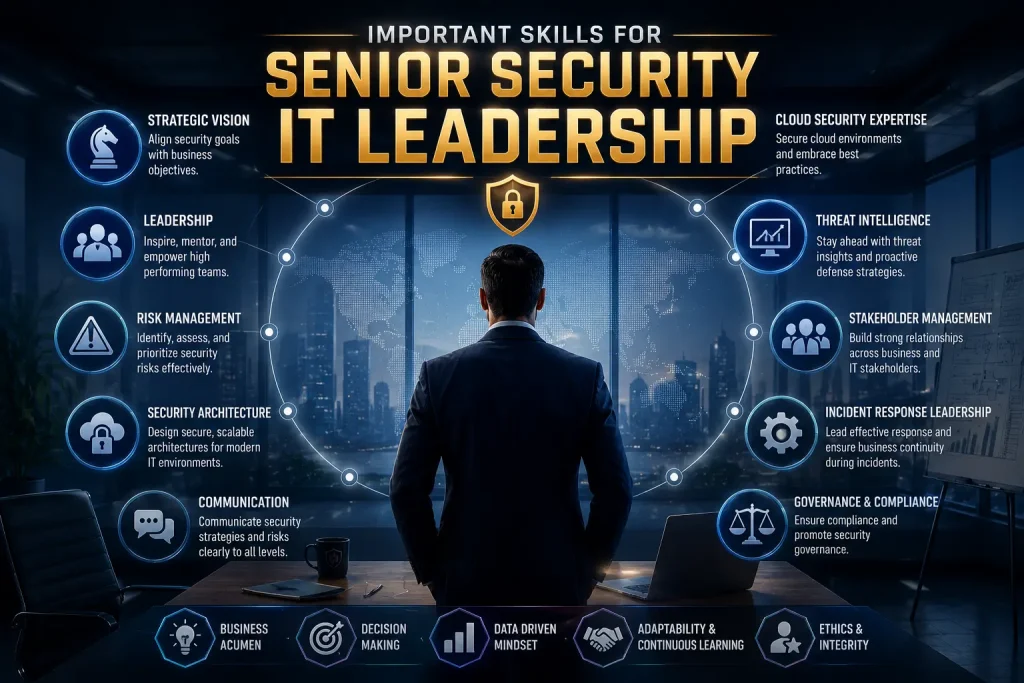
Senior security professionals need a combination of technical, strategic, and interpersonal skills.
Technical Understanding
Leaders should understand areas such as:
- Networks
- Cloud infrastructure
- Applications
- Databases
- APIs
- Identity management
- Security architecture
They do not necessarily need to configure every system personally, but they should understand how different technologies create or reduce risk.
Risk Management
Leaders must prioritize issues based on potential business impact.
Strategic Thinking
Cybersecurity decisions should support long-term technology and business goals.
Communication
Complex security issues must be explained clearly to both technical and non-technical stakeholders.
Incident Leadership
Security incidents require fast decisions, coordination, and clear responsibilities.
Team Development
Strong leaders build teams rather than becoming the only person capable of making important decisions.
Common Security Leadership Mistakes
Even experienced organizations can make cybersecurity mistakes.
Buying Tools Without a Strategy
More security software does not automatically create better security.
Organizations must understand what problems each tool is solving.
Treating Security as an IT-Only Issue
Security affects operations, customers, finance, legal responsibilities, employees, and reputation.
It therefore requires organization-wide involvement.
Ignoring Basic Controls
Advanced security technology cannot compensate for weak passwords, excessive permissions, missing updates, or poor backups.
Focusing Only on Prevention
Organizations must also prepare for detection, response, and recovery.
Failing to Test Recovery Plans
Written plans may look impressive but fail during real incidents.
Testing reveals weaknesses before an emergency.
How Organizations Can Strengthen Security Leadership
Businesses looking to improve their security leadership can begin with several practical steps.
Identify Critical Assets
Determine which systems and information are most important to business operations.
Assess Risk
Evaluate vulnerabilities, threats, and potential business consequences.
Define Ownership
Every critical security responsibility should have a clear owner.
Establish Policies
Create practical rules for access, devices, applications, data, cloud services, and incident reporting.
Improve Visibility
Implement monitoring where meaningful security events can be identified.
Prepare for Incidents
Document response responsibilities and escalation procedures.
Test Recovery
Regularly verify whether important systems and information can be restored.
Measure Progress
Security should be evaluated using meaningful metrics rather than assumptions.
Security Metrics Senior Leaders Should Track
Metrics help leadership understand whether security programs are improving.
Useful measurements can include:
- Number of critical vulnerabilities
- Time required to fix critical issues
- Number of privileged accounts
- Multifactor authentication coverage
- Security incident volume
- Incident response time
- Backup success rate
- Recovery testing results
- Security training completion
- Unresolved high-risk findings
Metrics should support decisions.
Collecting large amounts of security statistics without connecting them to business risk can create unnecessary complexity.
The Future of Senior Security IT Leadership
Cybersecurity leadership continues to evolve as technology environments change.
Artificial intelligence, cloud computing, automation, connected devices, distributed applications, and increasingly complex software supply chains are creating new opportunities as well as new risks.
Future security leaders will need to understand how rapidly changing technologies affect:
- Access control
- Data privacy
- Application security
- Infrastructure security
- Software development
- Regulatory compliance
- Threat detection
- Risk management
Automation will likely handle more repetitive security tasks, but leadership judgment will remain important.
Organizations still need people who can evaluate competing priorities, understand business consequences, and make responsible decisions.
Frequently Asked Questions
What does Trango Tech senior security IT leadership mean?
Trango Tech senior security IT leadership refers to the strategic management of cybersecurity, technology risk, IT governance, secure software development, data protection, and operational resilience within a modern technology environment.
Why is senior IT leadership important for cybersecurity?
Senior leadership connects technical security decisions with business goals. It helps organizations prioritize risks, establish responsibilities, allocate resources, prepare for incidents, and develop long-term security strategies.
What are the main responsibilities of a senior security IT leader?
Common responsibilities include cybersecurity strategy, risk management, IT governance, cloud security, application security, identity management, incident response, compliance, data protection, and business continuity.
Is cybersecurity leadership only responsible for preventing attacks?
No. Prevention is only one part of cybersecurity. Effective leadership also focuses on detecting suspicious activity, responding to incidents, recovering systems, maintaining business continuity, and reducing future risk.
What is security by design?
Security by design means considering security requirements while software and technology systems are being planned and developed instead of adding security controls only after development is complete.
Why is cloud security important for senior IT leaders?
Organizations increasingly depend on cloud platforms for applications, infrastructure, storage, and business operations. Leaders must ensure cloud permissions, configurations, data protection, monitoring, and recovery processes are properly managed.
How does IT governance improve cybersecurity?
IT governance establishes clear technology policies, responsibilities, approval processes, and standards. It reduces inconsistent decisions and helps ensure security practices are applied across the organization.
Conclusion
Trango Tech senior security IT leadership represents more than technical cybersecurity management. Strong leadership connects security with software development, cloud infrastructure, data protection, risk management, governance, incident response, and long-term business resilience.
Organizations cannot rely on individual security tools to protect increasingly complex digital environments. They need clear priorities, defined responsibilities, practical policies, secure development practices, effective monitoring, and tested recovery processes.
The strongest security leaders also understand that cybersecurity must support business progress. They protect critical systems without creating unnecessary barriers to innovation.
As digital operations continue expanding, senior security IT leadership will remain essential for organizations that want to build technology that is secure, scalable, reliable, and prepared for changing risks.
